


Air Removal Techniques in Pillow Compression Machines Explained
- hongdemat
- Apr 17
- 5 min read
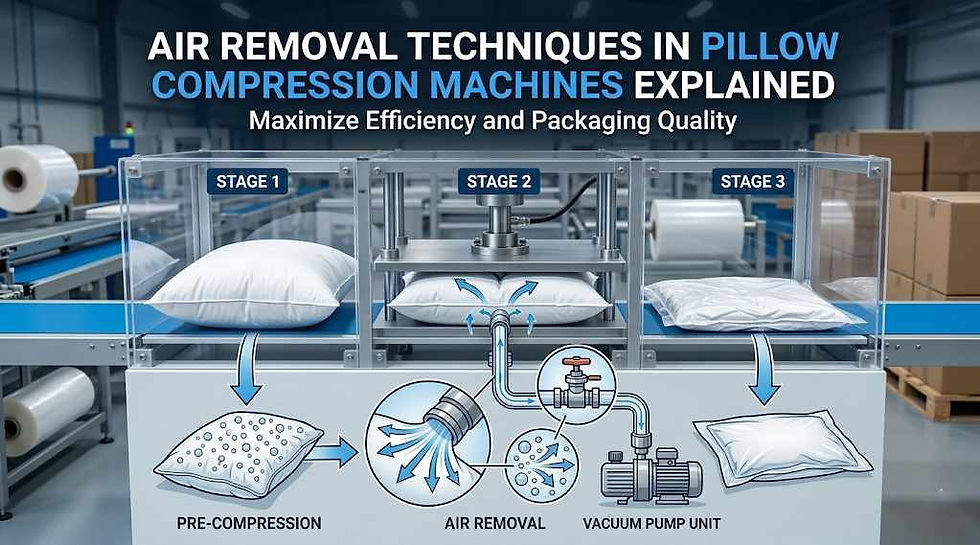
The logistics of the bedding and textile industry are defined by a single, invisible enemy: air. A standard pillow is about 90 percent air by volume. This gives pillows the loft and comfort consumers want. However, it causes huge inefficiency in storage and shipping. Without effective compression, transporting pillows means shipping mostly air.
Understanding the air-removal techniques in modern machinery is essential for manufacturers looking to scale. These processes rely on complex physics, material science, and mechanical engineering. This guide explains how air is extracted, what hardware is involved, and why certain methods suit specific materials.
The Core Principles of Air Displacement
Air removal is not just about squashing a product. It is a controlled displacement process. When a pillow is placed under load, the air trapped within the filling fibers, whether polyester fiberfill, memory foam, or down, must find a path of least resistance to exit the product.
If air is removed too quickly or unevenly, the filling's internal structure can be damaged, or the outer casing (the ticking) can rupture. Sophisticated machinery balances speed with material integrity. Manufacturers typically utilize two primary methods for this: mechanical press displacement and vacuum suction.
Mechanical Platen Compression
The most common technique used by a pillow compressing machine manufacturer involves mechanical platens. This method relies on physical force to squeeze air out through the microscopic gaps in the pillow’s fabric.
In this setup, the pillow is placed between two heavy-duty metal plates. These plates are usually powered by pneumatic or hydraulic cylinders. As the plates close, the pillow's internal pressure increases. Because the pillow's fabric is semi-permeable, air is forced out through the cloth's weave.
Gradual vs. Rapid Pressing
A human-centric approach to machine design prioritizes variable pressure. Modern machines do not simply "slam" shut. Instead, they use a multi-stage pressing cycle. The first stage removes the "bulk" air, the air between the pillows. The second stage targets the "interstitial" air, the air trapped between individual fibers. By slowing down the final few inches of compression, the machine ensures the air exits without causing "ballooning," which can lead to uneven compression or fabric tears.
Vacuum Suction and Hermetic Sealing
While mechanical pressing removes air through force, vacuum techniques remove air through pressure differentials. This technique is often used in tandem with a plastic film wrap.
In a vacuum-based system, the pillow is placed in a high-barrier plastic bag. A nozzle or vacuum chamber lowers the air pressure around or inside the bag. Nature abhors a vacuum, so air inside the pillow rushes out to fill the low-pressure area.
The Role of Atmospheric Pressure
It is a common misconception that the machine "crushes" the pillow. In reality, once the internal air is removed, the surrounding atmosphere (about 14.7 psi at sea level) holds the pillow in its compressed state. This creates a thinner profile than mechanical pressing alone, since atmospheric pressure is uniform across the entire product surface.
Combined Cycle Techniques
The most advanced machines on the market today use a combined cycle. This involves a mechanical press to flatten the product, followed immediately by a vacuum seal to maintain that flatness.
The mechanical press does the "heavy lifting" of moving the bulk of the air, saving energy and reducing wear and tear on vacuum pumps. Once the platens reach their maximum compression, a heat sealer seals the plastic film, and a small vacuum burst removes any remaining pockets. This dual approach is the gold standard for high-volume shipping, where every millimeter of space saved translates to thousands of dollars in freight savings.
Air Removal Challenges in Different Materials
Not all pillows behave the same way under air removal protocols. The material composition dictates the technique.
Polyester Fiberfill
Fiberfill is resilient but has a high "spring back" memory. Air removal must be absolute. If even a small amount of air remains, the fibers will use that oxygen to slowly expand, eventually causing the packaging to "bloat" or "pop" in the warehouse.
Memory Foam
Memory foam is an open-cell structure. It acts like a sponge. Removing air requires slower, sustained pressure. If air is removed too quickly, the cells may collapse permanently. This prevents the pillow from recovering its shape once the customer opens it. Because of this, high-end memory foam pillow compressing machines include "dwell time" settings. Here, pressure is held constant for several seconds to let the cells vent safely.
Feather and Down
Feather pillows are hardest to compress because the feather quills are sharp. Too much force can push quills through the fabric or plastic, breaking the vacuum seal. Air removal for down pillows needs gentler, more voluminous extraction, not high-pressure force.
The Importance of the Sealing Interface
Air removal is pointless if air can re-enter. The final stage of any compression cycle is the heat seal. A professional-grade machine uses a pulse-sealing or constant-heat sealing bar to fuse the plastic layers.
Seal quality is measured by width and consistency. A 10mm seal is better than a 3mm seal. The wider seal offers more protection against micro-leaks. If air is not removed completely, the seal is constantly under stress from expanding air. This leads to frequent product failure.
Engineering for Maintenance and Longevity
From a mechanical perspective, the air-removal system is the most stressed part of the machine. Pneumatic cylinders and vacuum filters require regular attention.
In mechanical press systems, the platens must remain perfectly parallel. Even a slight tilt can trap air on one side of the pillow, creating a "wedge" shape that makes boxing and palletizing nearly impossible. In vacuum systems, the primary maintenance concern is the filtration of "lint" or "fly" fibers. As air is sucked out of the pillows, tiny fragments of polyester or down are pulled along. Without a high-capacity filtration system, these fibers can enter the vacuum pump, causing overheating and eventual mechanical failure.
Impact on Logistics and Sustainability
The main reason to advance air removal techniques is to cut costs. By shrinking pillow volume by up to 75 percent, companies can fit four times more products in a single container. This lowers the carbon footprint per unit and greatly reduces shipping costs.
Compressed pillows are also easier for consumers to handle. The bed-in-a-box movement was only possible thanks to these advances in air removal. Shrinking a king-sized pillow to the size of a book has changed e-commerce for home goods.
Choosing the Right Machine
For businesses, the right technique depends on daily volume and the variety of materials. A manual press works for small boutique manufacturers. For industrial-scale operations, fully automated combined cycle machines are needed.
When evaluating a machine manufacturer, check the specifications of vacuum pumps and platen cycle times. A machine that removes air in 5 seconds instead of 10 seconds can double production capacity in a single shift.
Summary of the Technical Process
The science of air removal in pillow compression is a balance of force, pressure differentials, and material awareness. By understanding the difference between mechanical displacement and vacuum extraction, manufacturers can choose the right tools to protect their product integrity while maximizing their shipping efficiency. Whether dealing with the resilience of polyester or the delicate nature of down, the goal remains the same: removing the air today to ensure a comfortable sleep for the customer tomorrow.


Comments