


How to Choose a Pillow Compressing Machine Manufacturer for Bulk Export Orders
- hongdemat
- Apr 14
- 7 min read
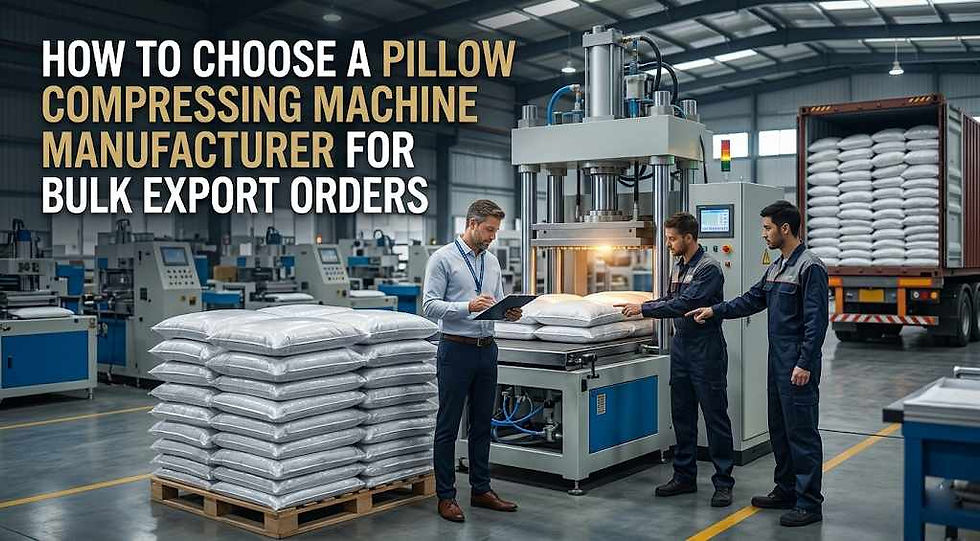
Sourcing industrial machinery for export is a high-stakes process. When you are dealing with bulk orders of pillow compressing machines, the margin for error is razor-thin. You are not just buying a piece of equipment; you are buying a relationship that will dictate your supply chain efficiency, freight costs, and ultimately, your profit margin for years to come.
A pillow compressing machine does exactly what the name suggests: it reduces the volume of pillows, cushions, or soft bedding by up to 70 to 80 percent. For an exporter shipping containers from Asia to Europe or North America, this volume reduction is the difference between breaking even and making a healthy return. However, not all machines are built for the relentless, high-cycle demands of export packing lines.
This guide cuts through the sales brochures and focuses on the verifiable, practical, and often overlooked factors that separate a reliable long-term partner from a costly mistake.
The Non-Negotiable Foundation: Certifications and Compliance
Before you even look at the speed of the hydraulic ram or the thickness of the steel frame, you must verify the legal and safety standing of the pillow compressing machine manufacturer. This is not optional fluff; this is the gatekeeper for global trade.
For bulk export, the machine will travel through multiple ports and be plugged into different electrical grids. If it lacks the proper certifications, customs will seize your container, or, worse, your buyer’s local safety inspector will red-tag the machine on arrival.
When vetting a manufacturer, demand to see the following verifiable documentation:
CE Marking (For Europe and Beyond): Do not just look for the sticker on the machine photo. Request a copy of the Declaration of Conformity and the Technical File Number. A legitimate manufacturer can provide these within hours. If they stall or say, "We can put a sticker on for you," walk away. That sticker is a legal document in the EU, not a decoration.
ISO 9001:2015 Certification: This is the baseline for consistent quality management. However, here is a unique, verifiable tip: Check the Scope of the Certificate. A company might be ISO certified for "Trading of Machinery" but not for "Manufacturing of Hydraulic Presses." If the scope is limited to trading, you are dealing with a middleman, not a factory. You want the scope to explicitly cover manufacturing or fabrication.
Electrical Component Traceability: Export machines often fail because of voltage fluctuations or humidity at sea. Insist on a detailed Bill of Materials (BOM) that lists the brand of the motor, PLC, and contactors. Verifiable brands like Siemens, Schneider, Omron, or Delta ensure that if a relay fails in a warehouse in Rotterdam, the local electrician can find a replacement part in 24 hours. If the BOM lists a generic "local brand" with no part number, you will be air-freighting a five-dollar part for $200 later.
Assessing Structural Integrity for Container Loading
This is where the human eye and a few specific questions separate the export-ready machine from the domestic workshop model. Many small shops build machines that work fine in their local market, where the machines sit on concrete floors for a decade. Export requires the machine to be forklifted, strapped down on a flat rack, and possibly bounced across potholed roads in the destination country.
You need to verify the Steel Thickness and Frame Construction. Do not accept "Heavy Duty" as a descriptor. Request the millimeter measurements of the main vertical pillars and the table plate. For a machine compressing pillows for 8 to 10 hours a day in an export hub, you want a minimum of 16mm to 20mm plate steel on the pressure table. Anything thinner will warp within the first year, causing misalignment of the sealing bar (if it's a bagging compressor) or uneven compression.
Also, inquire about the Welding Seam Inspection Process. A verifiable manufacturer will mention "Ultrasonic Testing" or "Magnetic Particle Inspection" of critical joints. This is standard in pressure vessel manufacturing, but often skipped on cheaper pillow presses. Without this, microfractures from ocean freight vibration can turn into catastrophic cracks when the hydraulic cylinder hits 10 tons of pressure six months later.
The Hydraulic Heart of the Machine
The hydraulic system is the engine. It is also the component most likely to leak during transit or fail upon startup. For export orders, the conversation must center on Oil Cleanliness and Sealing Standards.
A verifiable quality indicator is the NAS 1638 Cleanliness Class of the hydraulic oil and system. Top-tier manufacturers will assemble the hydraulic circuit in a clean room environment and flush the system to NAS 7 or NAS 8 standards. Why does this matter for export? If the system is built with metal shavings or dust inside (common in open-air assembly shops), those contaminants will circulate and destroy the pump seals during the first few thousand cycles. You won't see this in a 60-second demo video; you'll see it on a service call six months after installation.
Ask the potential pillow compressing machine manufacturer this specific question: "Do you flush the hydraulic lines and tank with filtered oil prior to testing, and can you provide a fluid sample report?"
If the salesperson has no idea what you are talking about, you are speaking with a general trading company. If they answer with a clear "Yes, we use a 5 micron offline filtration loop for 2 hours," you are dealing with a serious factory.
Customization That Actually Saves Money
Bulk export orders mean you have leverage. However, using that leverage for a 2 percent discount is short-sighted. Use your bulk order size to demand Value Engineering that reduces your total landed cost.
For instance, the standard machine frame is often a welded monoblock. That is cheap to make but expensive to ship because it creates a lot of empty volume in the container. A savvy pillow compressing machine manufacturer will offer a Split Frame Design for bulk orders. This allows the main press body to be unbolted and nested inside the feeding conveyor frame.
This isn't a complex engineering feat; it's just intelligent packaging. Ask for the SKD (Semi-Knocked-Down) shipping dimensions. You might find that a standard 40-foot High Cube container holds 6 fully assembled units, but 18 semi-knocked-down units of the same model. The freight savings on that extra volume usually cover the cost of a technician's flight to supervise reassembly at the destination.
The Language of After Sales: Verifiable Response Metrics
Everyone promises "24/7 service." That phrase is meaningless without a verifiable mechanism. When you are exporting 50 machines to a distribution center, you need a warranty structure that accounts for time zones and logistics.
Do not settle for a WhatsApp number. Require a Service Level Agreement (SLA) Draft with the initial quote. The SLA should include:
Remote Diagnostic Capability: Does the PLC have an Ethernet port for VPN connection? If the machine is in Poland and the engineer is in Shanghai, this is the only way to fix a software glitch on day one.
Spare Parts Ex Works Time: The agreement should state "Spare parts shipped within 72 hours of fault confirmation."
Wear Parts Kit Inclusion: For a bulk order, the container should include a pallet of common wear items: hydraulic seals, sealing wires (for bag seal models), and sensor eyes. The cost of this kit added to the ex works price is negligible compared to the cost of air freight for a single seal later.
Navigating the Geography of Manufacturing
The global supply chain for these machines is heavily clustered in specific industrial belts. While there are competent builders in Turkey and Eastern Europe, the bulk of global production comes from China, specifically the regions around Guangdong (for general machinery) and Shandong (for hydraulic equipment).
A verifiable way to identify a legitimate pillow compressing machine manufacturer versus a reseller is to review their Business Scope License (available via public records in China) and their Factory Audit History. Ask if they have passed a Bureau Veritas or SGS factory audit in the last 12 months. These third-party audits verify that the address they claim to occupy actually contains welding bays, lathes, and assembly floors, not just a carpeted office with a sample machine in the corner.
The Final Test: The Video Call Audit
Before signing a contract for 30 or 50 units, conduct a live video tour. Do not let them show you a pre-planned path. Here is what you look for that cannot be faked:
The Floor: Look at the concrete under the machines. Is it stained with years of hydraulic oil and weld spatter? Good. That is a working factory.
The Test Bench: Ask to see a machine currently under load test. Watch the pressure gauge. It should hold steady at the max tonnage (e.g., 10T or 15T) for at least 15 seconds without the needle dropping. A drop indicates internal cylinder bypass.
The Documentation Shelf: Ask the worker on camera to pick up the Hydraulic Schematic Diagram for the specific model. If they can find it in 30 seconds, the factory is organized. If there is panic and confusion, the documentation for your export order will be just as chaotic.
Conclusion
Choosing a manufacturer for bulk export is about mitigating the risk of distance. The machine itself is a fairly straightforward application of Pascal's Law. The complexity lies in ensuring that the steel doesn't crack at sea, the oil stays clean, and the electrician in Sydney understands the wiring diagram.
Do not get distracted by shiny paint or a low unit price. Focus on the material thickness, the cleanliness of the hydraulic assembly, and the verifiable existence of a technical file. A reliable pillow compressing machine manufacturer will welcome these technical questions because they prove you are a serious buyer who knows the true cost of ownership extends far beyond the ex works price tag. Your pillows are soft, but your business machinery needs to be as hard as nails.


Comments