


Pocket Spring Mattress Market Trends: What B2B Buyers Should Know in 2026
- hongdemat
- Mar 18
- 5 min read
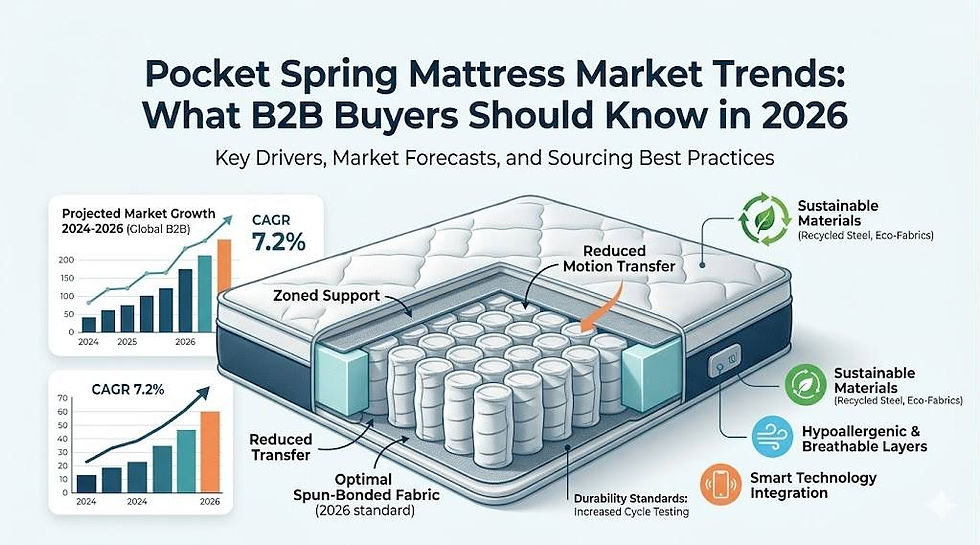
The pocket spring mattress market is shifting faster than it has in years. If you're sourcing bedding products for retail chains, hotels, or property developers, understanding where the market is heading isn't optional anymore. It's the difference between making smart purchasing decisions and scrambling to catch up with competitor inventory.
Let's look at what's actually changing, what's sticking around, and how to approach your supplier relationships in 2026.
The Reality of Growing Demand in Specific Segments
Global mattress demand has fractured. The one-size-fits-all approach is dead.
What's driving real growth isn't premium luxury beds or cheap imports anymore. It's the middle segment where people actually make purchasing decisions. Hotels and hospitality operators want mattresses that balance durability, comfort, and cost efficiency. They need systems that hold up to 300-plus nights of use per year without falling apart. Residential buyers want better quality than they bought five years ago, but they're not emptying their wallets.
Pocket spring construction fits this gap perfectly. Unlike memory foam, which breaks down and loses responsiveness, pocket springs maintain consistent support. They cost less than high-end latex but deliver noticeably better performance than basic foam core. For B2B buyers, this means the segment is growing 4-6 percent annually in mature markets, faster in emerging economies.
One pocket spring mattress exporter in South Asia noted that orders from European retailers jumped 35 percent between 2024 and 2025. That's not anomaly. It's a trend.
Supply Chain Reset and Production Consolidation
The mattress industry spent years decentralized across dozens of countries. That's changing.
Production is consolidating around regions with access to raw materials, energy infrastructure, and skilled labor. India, Vietnam, and Indonesia are becoming dominant manufacturing hubs. Not because of lower wages alone, but because they're developing integrated supply chains. Raw coil manufacturers, foam producers, and fabric suppliers exist in clusters now.
This matters for buyers because sourcing is becoming more efficient. A pocket spring mattress exporter today can often secure better pricing and quality consistency than fragmented producers could five years ago. Lead times are shortening. Minimum order quantities are becoming more flexible for established buyers.
However, this consolidation comes with risk. Fewer suppliers means less redundancy. If production hiccups happen in one region, alternatives dry up quickly. Smart buyers are maintaining relationships with at least two primary suppliers in different countries.
Material Cost Stability and Quality Expectations
Coil steel prices have stabilized after years of volatility. That's good news. But the real action is happening in secondary materials.
Foam quality is improving. Densities that used to cost twice as much five years ago are now available at previous pricing. Fire-retardant fabrics have become mandatory in most markets, and suppliers have absorbed those costs into standard pricing rather than passing them to buyers.
What's tightening is durability certification. Regulatory bodies are getting stricter about durability claims. A mattress marketed as "10-year life" needs backing. Buyers should expect suppliers to provide testing documentation. Certifications like CertiPUR-US for foam or ISO standards for construction quality are becoming non-negotiable.
The market is also recognizing that "cheaper" isn't the same as "value." A bed that costs 20 percent less but lasts 30 percent less long creates customer dissatisfaction and warranty claims. Sophisticated B2B buyers are calculating total cost of ownership across the lifespan, not just unit price.
The Sustainability Question That's Actually Moving Markets
Sustainability went from buzzword to operational requirement somewhere around 2023. It's stuck.
Manufacturers using recycled steel, plant-based foams, and eco-certified fabrics are charging small premiums and getting them. Hotel groups and larger retailers are building sustainability into procurement mandates. Even budget-conscious hospitality operators are factoring environmental metrics into supplier selection.
But this isn't about virtue. It's about the cost of waste and brand reputation. A guest sleeping in a sustainably-sourced bed isn't necessarily paying more. The hotel is absorbing cleaner material costs because the alternative is PR problems and regulatory scrutiny.
For B2B buyers, this means asking suppliers specific questions. What percentage of materials are recycled? What happens to production waste? How are coils sourced? Generic "sustainable" marketing is disappearing in professional supply relationships. Specificity is what matters now.
Customization and Flexibility in Ordering
The era of massive standardized batch runs is softening.
Suppliers are investing in production flexibility because buyers increasingly want options. Different comfort levels. Custom firmness profiles. Special covers for hospitality use. Smaller retailers want 50-unit orders of multiple variations instead of 500 units of one configuration.
This flexibility has traditionally been available only at premium prices. That's changing. Modular production approaches mean a pocket spring mattress exporter can produce diverse SKUs without sacrificing efficiency.
The trade-off is higher coordination overhead. Buyers need to forecast better and communicate specifications clearly. But for retailers trying to differentiate inventory or for property developers building mixed-use projects, this flexibility is enormous.
Regional Dynamics and Market Growth Rates
Not all markets are growing equally.
North America and Western Europe are growing 2-3 percent annually. Growth is steady but not explosive. The market is mature. Buyers know what they want.
Southeast Asia and South Asia are growing 6-8 percent. Middle East markets are hitting 5-6 percent. These regions have rising middle classes buying mattresses for the first time. Hospitality development is accelerating. Construction of new hotels, hostels, and service apartments is boom-level in some countries.
For B2B buyers, this means sourcing opportunities. Suppliers in high-growth markets are expanding production to meet local demand but maintaining export capacity. Lead times are reasonable. Pricing is competitive because capacity is abundant.
But growth also brings competition. Suppliers in these regions are increasingly competing with each other, not just with established manufacturers in developed countries. This is driving quality improvements and efficiency gains across the board.
Logistics and Lead Time Realities
Shipping remains volatile but more predictable than 2022-2023.
Container costs have normalized. Shipping times from major manufacturing countries to North America and Europe are 25-35 days typically, not the chaotic uncertainty of recent years. However, "normal" is still higher than pre-2020 conditions.
Smart buyers are factoring in lead times differently now. Rather than just-in-time inventory strategies that worked ten years ago, buyers are building 4-6 week buffers. For major retail seasons or property development timelines, that matters. Planning needs to happen in advance.
Port congestion is regional. Some ports have it sorted. Others are still backlogged. Buyers working with suppliers should ask specifically about shipping routes and ports of departure.
What Buyers Should Do Right Now
Start by auditing your current supplier relationships against these trends. Are they consolidating production? Can they offer flexibility? Do they have sustainability documentation? How are they handling lead times?
Diversify your supplier base. One pocket spring mattress exporter shouldn't be your only source. Different suppliers bring different expertise, capacity, and risk profiles.
Demand specifics. Generic claims about quality, durability, or sustainability don't hold up anymore. Get certifications. Get test results. Get clarity on material sourcing.
Think about total cost, not unit price. A mattress that lasts longer, requires fewer warranty claims, and resists market commodity pricing changes is worth more even if the invoice says higher number.
Talk to your suppliers about forecasts. If they understand your buying patterns 6-12 months out, they can plan production, lock in material costs, and give you better pricing. This works in both directions.
The Bottom Line
The pocket spring mattress market in 2026 is more professional, more efficient, and more segmented than it was five years ago. Suppliers are better organized. Buyers have more options. Quality is more predictable.
But it's also faster. Decisions that used to take months are happening in weeks. Trends that used to take two years to establish are shifting in quarters.
Smart B2B buyers are staying ahead by staying informed, maintaining flexibility, and building real relationships with suppliers who understand these shifts. The market is rewarding that approach.


Comments